Death and Fear of Death
The CallerDeath and fear of death are not confined to a single crisis: they surface in ordinary routines, in the prospect of illness and bereavement, and in false announcements that make the living confront their own deaths. The novel sets private awareness of mortality beside its public signs—televised reports, obituaries, and funeral arrangements—showing how a person can be frightened by death long before it arrives, and how its procedures can be invoked even when the news is untrue.
Mortality in Ordinary Life
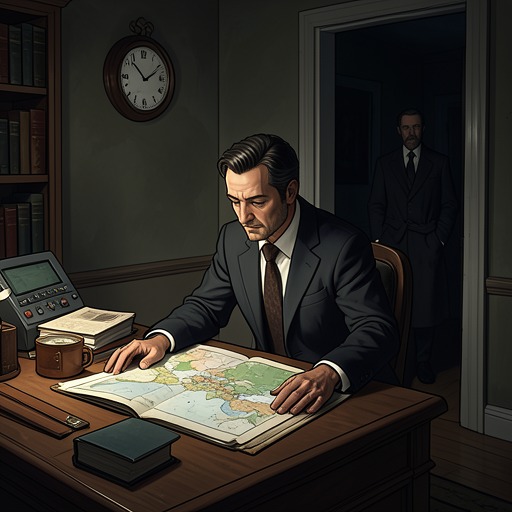
After seeing himself repeatedly on television, Konrad Sejer studies the visible effects of age: he is greyer, thinner, and more sharply outlined in the face. The image turns his thoughts toward death as something that grows within and gradually takes over the features. His reflection is not an abstract meditation detached from the story. It comes after the sight of his own name and title on screen, when public authority and private vulnerability occupy the same image. He pushes the thought away by patting Frank, then thinks of his grandson, Matteus. The movement from his own aging body to the child’s future briefly restores a sense of continuity, though it does not cancel his awareness of mortality.
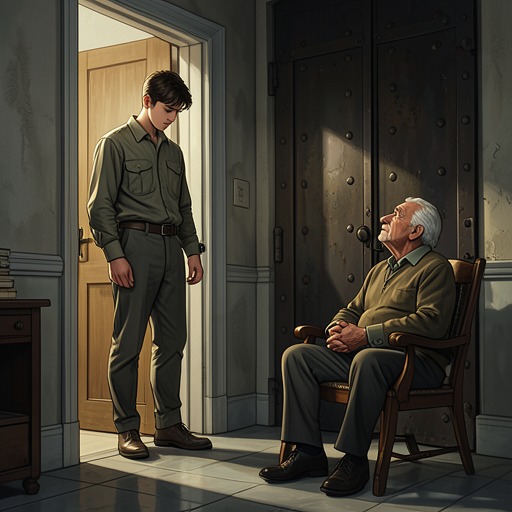
Sejer’s solitude gives that awareness a history. Near midnight, in the darkened living room among the heavy oak furniture inherited from his parents, he imagines his dead wife, Elise, in the chair by the window. She died of cancer, leaving him a young widower whose life took a different course from the one he had expected. The imagined domestic reassurance of her presence is explicitly only a fantasy; the empty chair marks the absence that remains. His thoughts move between the dead, the living family he worries about, and the ordinary act of going to bed. In this way, mortality enters not as a dramatic revelation but as a pressure within familiar rooms and habits.
Gunilla Mørk’s fear begins in another ordinary setting. Soon after celebrating her seventieth birthday with children, friends, and neighbours, she wonders whether she will reach eighty. She is active and clear-headed, takes pleasure in the bright morning, and believes people should appreciate what is good in their lives. Yet the birthday has made death newly difficult to set aside. Looking at the wrinkles on her hand, she briefly feels the force of age in a body that is still warm and capable. Her conviction that she should make the most of the day coexists with the sense that time is running short; the two responses are not resolved into a single attitude.
Death Announced Before It Occurs
The contrast between Gunilla’s settled morning and the obituary she finds makes mortality abruptly public. She reads the obituaries as a regular habit, noting birth years and recognizing how near her own generation is to the end of its allotted time. Then she sees her own name. The notice gives her birth date and declares that she died quietly in her sleep on July 25; its consoling lines describe rest and failing strength. She checks the details and finds them correct, so the notice cannot be dismissed at once as a simple mistake. Her response is physical as well as intellectual: she lets the newspaper fall and puts a hand to her heart, struggling to breathe. The false announcement forces her to read herself as already dead while she is sitting alive in her kitchen.
The incident makes the distinction between a death and its social representation unstable. A printed notice, complete with dates and familiar language of family remembrance, carries the authority of an obituary even though it describes a living woman. Its wording does not merely report death; for Gunilla, it momentarily creates the terrifying possibility that the report might be true. Against that printed claim, the kitchen’s cups and bowls are ordinary evidence of the life continuing around her. The episode turns a familiar part of the newspaper into an intimate threat, exploiting the trust normally placed in the forms by which a death is announced.
A related falsehood reaches Astrid Landmark in the form of a funeral pickup. When the caller arrives for Helge, Astrid grasps the door frame and insists that her husband is not dead: he is sitting by the window, watching them. The scene brings the machinery of death to the threshold before death has occurred. The person expected to be collected is still present in the house, and the false call makes Astrid name that fact plainly. Her reaction includes shock, but also sympathy for the man who has come on the mistaken errand; she asks who summoned him. The false announcement is therefore not only a threat to the household’s sense of safety. It puts a living person, a worried spouse, and a representative of funeral arrangements into immediate contact.
The Anticipation of Dying
For Helge, death is not a distant abstraction but the feared conclusion of a decline that is already changing daily life. At fifty-nine, he sits in a wheelchair while paralysis advances. Astrid knows that he may lose the ability to swallow, speak, and breathe. The television flickers in front of him, but he cannot follow the programme; she stands with her back to him, ironing. Their knowledge of what is coming does not make it easier to discuss. Even ordinary phrases about the future—another season or another holiday—have become difficult because neither can assume there will be another occasion.
The practical questions of bereavement press against the silence. Astrid thinks about what will happen to their house and to the cabin at Blefjell, which Helge named El Dorado despite the expense of maintaining it. She wonders whether she will manage the lawnmower, the winter snowblower, the dry exterior wood, and the fruit trees. These details do not lessen the gravity of his illness; they show how the prospect of his death spreads into the future of work and responsibility that she may face alone. Rather than sit with that knowledge, she keeps busy with tasks: she irons shirts that have already come out smooth from the dryer, plans bread-making and cleaning, and returns to the cellar to do laundry. Activity lets her postpone the truth for a while, even as it cannot remove it.
Helge’s fear is more explicit. He imagines being kept in a freezer for several days after death and then burned in an intensely hot cremation, picturing the skeleton curling in the casket. He asks Astrid for a solution or a miracle, even imagining the reprieve of being woken from a bad dream. His speech gives fear a concrete sequence—waiting, cold, heat—rather than treating death as a distant concept. Astrid continues ironing a blue shirt with a white collar and cuffs, one of his best, although she knows it will never be worn again. The shirt preserves a small domestic gesture in the face of an ending neither of them can reverse. When she looks back, Helge’s head has fallen to his chest and she wonders if he has died without her noticing; then she hears him handling the remote. The moment suspends her between the fear of death and the fact that he is still there.
The Funeral Car and the Boundary of Fear
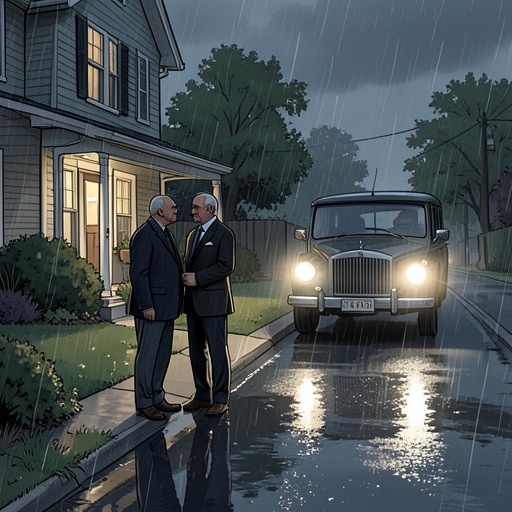
The funeral car gives this fear a physical form, but the later exchange about it complicates the earlier scenes of dread. Looking at Memento’s Daimler limousine, Helge asks whether he can make a reservation. The request follows a description of the car’s quiet engine and gentle, ship-like movement. The scene does not erase his earlier terror or establish that he has made peace with death. Instead, it places his question beside the very apparatus that had seemed to embody the frightening end he imagined. The car can be contemplated as a vehicle, with a ride whose smoothness he asks about, even while its purpose remains bound to death.
Narrative Significance
Together, these scenes distinguish the fact of mortality from the many ways it is anticipated, represented, or falsely imposed. Sejer sees age in his televised image and remembers the wife he lost; Gunilla reads a fabricated account of her own death; Astrid and Helge live with an actual decline while struggling to speak about its consequences. The false obituary and funeral pickup do not make anyone die, but they make death suddenly present through recognizable social forms. Helge’s illness, by contrast, makes the future bodily and domestic: a wheelchair, a shirt, a house, and a partner trying to stay occupied. The recurring fear is therefore not only of an ending, but of being forced to confront it—through a printed notice, an unexpected caller, the failing body, or the ordinary tasks that continue while someone is disappearing.